



“Every man is the architect of his own fortune.”
~ Appius Claudius Caecus, quoted by Sallust (Letters to Caesar, I, i)
In 2007, a survey by The Harris Poll found that 72% of Americans prefer classical federal buildings to modernist ones. A smaller 2020 study reached a similar conclusion. Besides a general dislike for their appearance, participants who disliked modernist federal buildings reported that their architectural style “disconnect[s] form from function,” making it difficult to understand the buildings’ purpose.
A 2017 study suggested that Swedes share Americans’ preference for classical architecture, though the study focused on residential complexes. It concluded that a “majority of the housing supply, built in what is generally considered to represent a contemporary [i.e., modernist] style, did not satisfy [potential buyers’] identified preferences concerning exterior architecture.” To condense participants’ responses in a pithy phrase, the researchers described modernist residences as “identical boring boxes.”
Despite laypeople’s distaste, modernist architecture continues to dictate the exterior and interior aesthetic of most new federal buildings, as well as university centers, apartment complexes, and virtually every construction project in the United States (and much of the world). For some, modernism’s monopoly stems from a general loss of interest in beauty and harmony as guiding architectural principles. Others explain it as the direct result of innovative work by 20th-century architects with visual impairments and war-related trauma.
Financial factors are also at play. Housing shortages have often prompted architects, contractors, and governments to choose cheap, mass-produced structures in modernist styles over classical alternatives. That has been the case for over a century.
The “economic argument” for modernist architecture seems intuitive. Just look at Los Angeles’ Disney Concert Hall. Surely a smooth metal, monochromatic exterior is cheaper than a richly adorned brick or stone façade, right?
Not quite. Material costs vary largely by market, but modernist buildings are rarely as affordable as we think. In 2016, Dutch researchers found that classical and modernist residential real estate in the Netherlands had similar construction costs. They also found that a majority of potential buyers were more likely to pay premiums on classical homes, mainly because supply didn’t meet demand. In other words, more potential buyers were searching for classical residences than construction companies were building them.
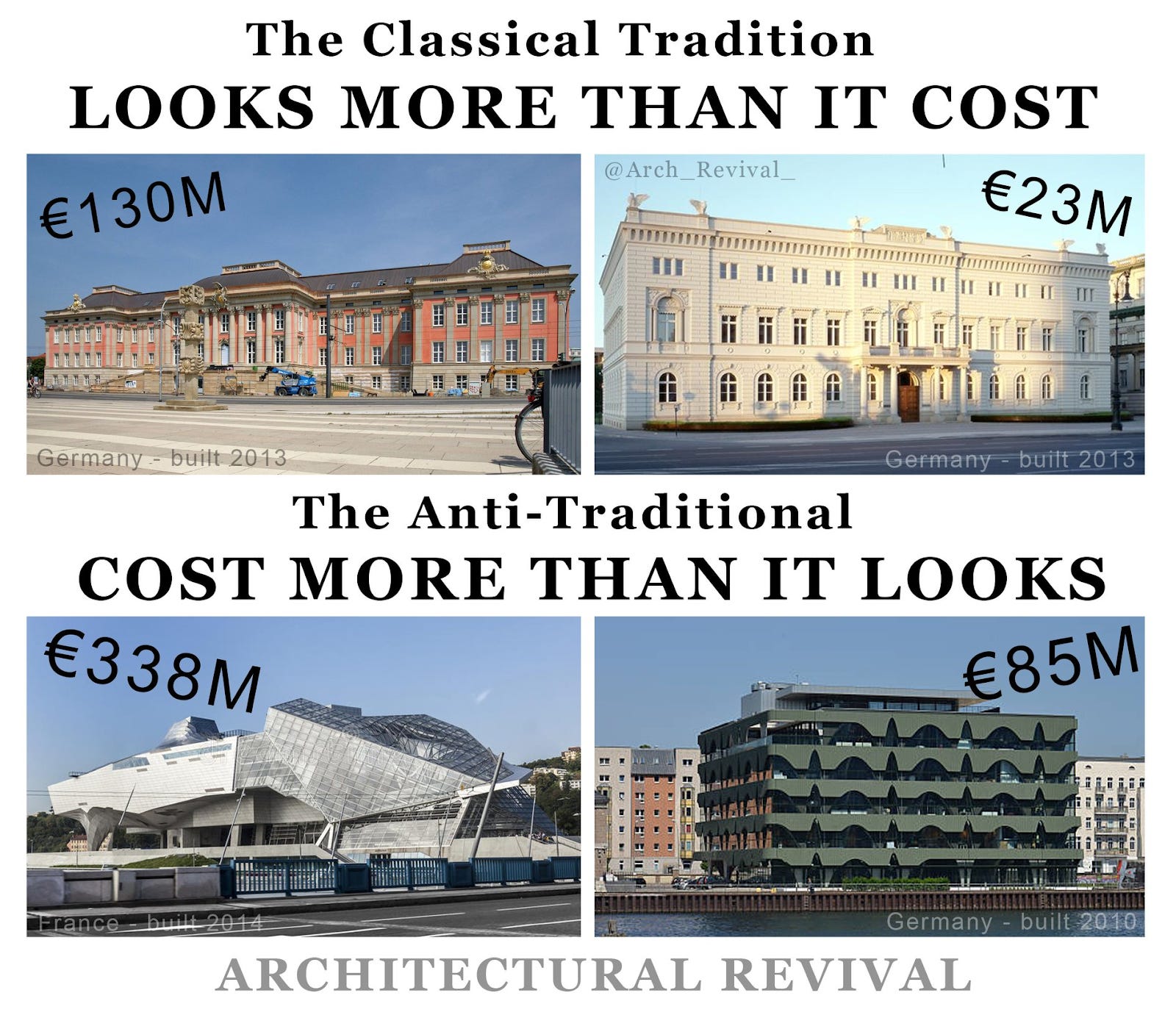
The same Swedish study cited above also found that, in Sweden, house developers can satisfy people’s aesthetic preferences “cost-effectively.” That is, modernist buildings are not cheaper than classical ones, at least not enough to treat them as the obvious economic option.
Despite unprecedented capital at their disposal, contemporary architects rarely satisfy people’s clear preferences. But let’s step back for a moment. What do “modernist” and “classical” mean?
Marcus Vitruvius’s “Ten Books on Architecture”
Pundits, architects, and cultural commentators debate incessantly over the merits and downsides of different architectural styles, often unaware that ancient thinkers had already broached the same topics.
Around 20 BCE, Marcus Vitruvius (80-15 BCE) dedicated a book to his patron: Rome’s first Emperor, Octavian Augustus. Vitruvius was a respected architect with several years of experience as a successful military officer. Although he’s not a household name, his “Ten Books on Architecture” profoundly shaped Western art and architecture, laying the foundations for “classicism.” The tome is primarily a construction manual, but it also discusses the ideal education of an architect, explains the fundamental role of symmetry in architectural projects, and much more.
We’ll return to Vitruvius soon. First, let’s look at some basic differences between classical and modernist architecture.
Modernism and Classicism in Architecture
Generally speaking, modernist architecture prioritizes blank, unadorned surfaces, hyper-geometric shapes, flat roofs, and sharp contrasts between horizontal and vertical lines. It either prefers rigid symmetry or disorienting disarray. Ornamentation (e.g., arches, engraving, etc.) is minimal or completely absent.
Unlike modernism, the classical (or “neoclassical”) style draws inspiration from Greek and Roman precedents. It uses columns, pediments, entablatures, domes, arches, and other elements that better reflect the harmonious proportions humans naturally appreciate. Ornamentation underscores beauty and grandeur. It also serves a symbolic role; decorative images often represent salient symbols, from simple ones (e.g., a country’s national bird, the papal seal, etc.) to full depictions of pivotal historical episodes (e.g., the Gigantomachy on Athens’ Parthenon’s frieze).
Although the principles of classical architecture were already in vogue in the ancient world, Vitruvius was the first to articulate them comprehensively. He condensed them into a “Triad.”
Vitruvius’s Triad
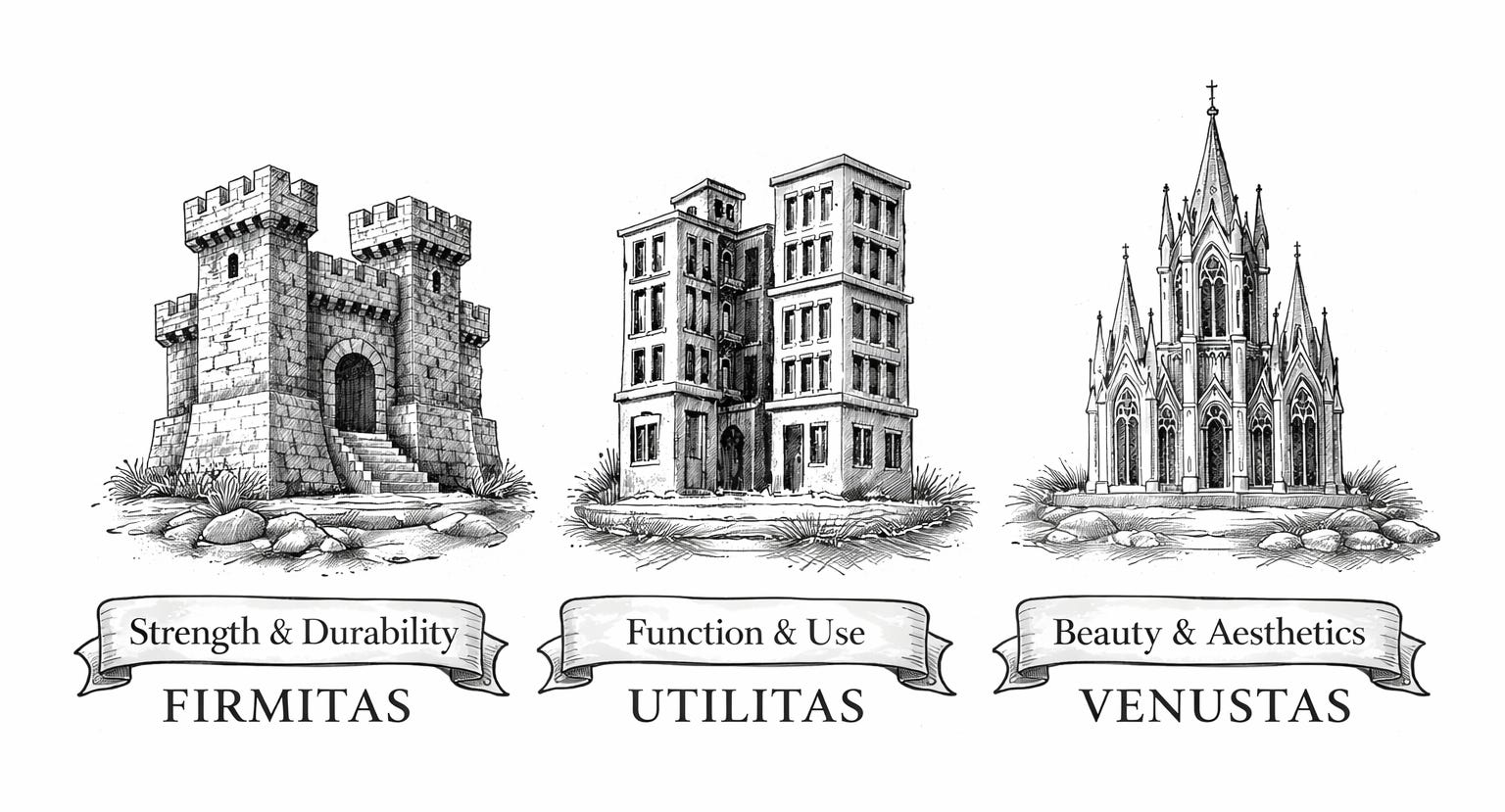
The first Vitruvian principle is firmitas (strength, durability). A well-designed structure must be stable and durable. It must withstand weather and time. Vitruvius emphasized selecting good materials that suit a building’s purpose as well as its location: durability “will be assured when foundations are carried down to the solid ground and materials wisely and liberally selected.”
Are the building materials resistant and hardwearing? Are they assembled safely? Basic though it is, firmitas is often a problem in urban development projects where demand requires fast and cheap construction.
Utilitas (utility), second in Vitruvius’ triad, concerns a building’s functionality. For Vitruvius, a structure should be designed to serve its intended purpose effectively. Its layout should be suited to the needs of its occupants. A building achieves maximum utility when the arrangement of its parts “is faultless and presents no hindrance to use, and when each class of building is assigned to its suitable and appropriate exposure.” What purpose is a building serving? And what are the best ways to optimize its interior space such that it facilitates that purpose?
We seem particularly good at maximizing utility, which has become the modern era’s guiding value. Yet our utilitarian attitude may undermine venustas (beauty), Vitruvius’ third principle. The word comes from “Venus,” the Latin name of the goddess of beauty and love. In Vitruvius’ view, a structure needs more than stability and function to be complete. It also needs to please at first glance and delight upon contemplation. It needs beauty.
For Vitruvius, there can be no beauty without symmetry, which he understood as “a proper agreement between the members of the work itself, and relation between the different parts and the whole general scheme.” For example, “in the human body there is a kind of symmetrical harmony between forearm, foot, palm, finger,” and so on.
The will to represent symmetrical harmony inspired countless artworks throughout antiquity and the Middle Ages, including, of course, Leonardo da Vinci’s “Vitruvian Man.”
There are many types of symmetry. Classical architecture does not consider them all equal. Rather, it prizes symmetry that distinguishes parts while embedding them into a cohesive whole. On the contrary, modernism prefers flat symmetry with undifferentiated parts.
The U.S. Tax Court Building is perfectly symmetrical. By Vitruvius’s standards, however, it falls short of its aesthetic potential. That’s because it doesn’t mimic natural proportions. “Proportion,” Vitruvius wrote, “is a correspondence among the measures of the members of an entire work, and of the whole to a certain part selected as standard.”
“Correspondence” between parts implies variation. For a building to be symmetrical and proportionate, it should have different parts of different sizes that together make one varied but unified whole. The “parts” of the U.S. Tax Court Building are almost indistinguishable. The building is very “symmetrical,” but it’s less beautiful. Now compare the U.S. Supreme Court Building, completed in 1935 by American architect Cass Gilbert (below, left).
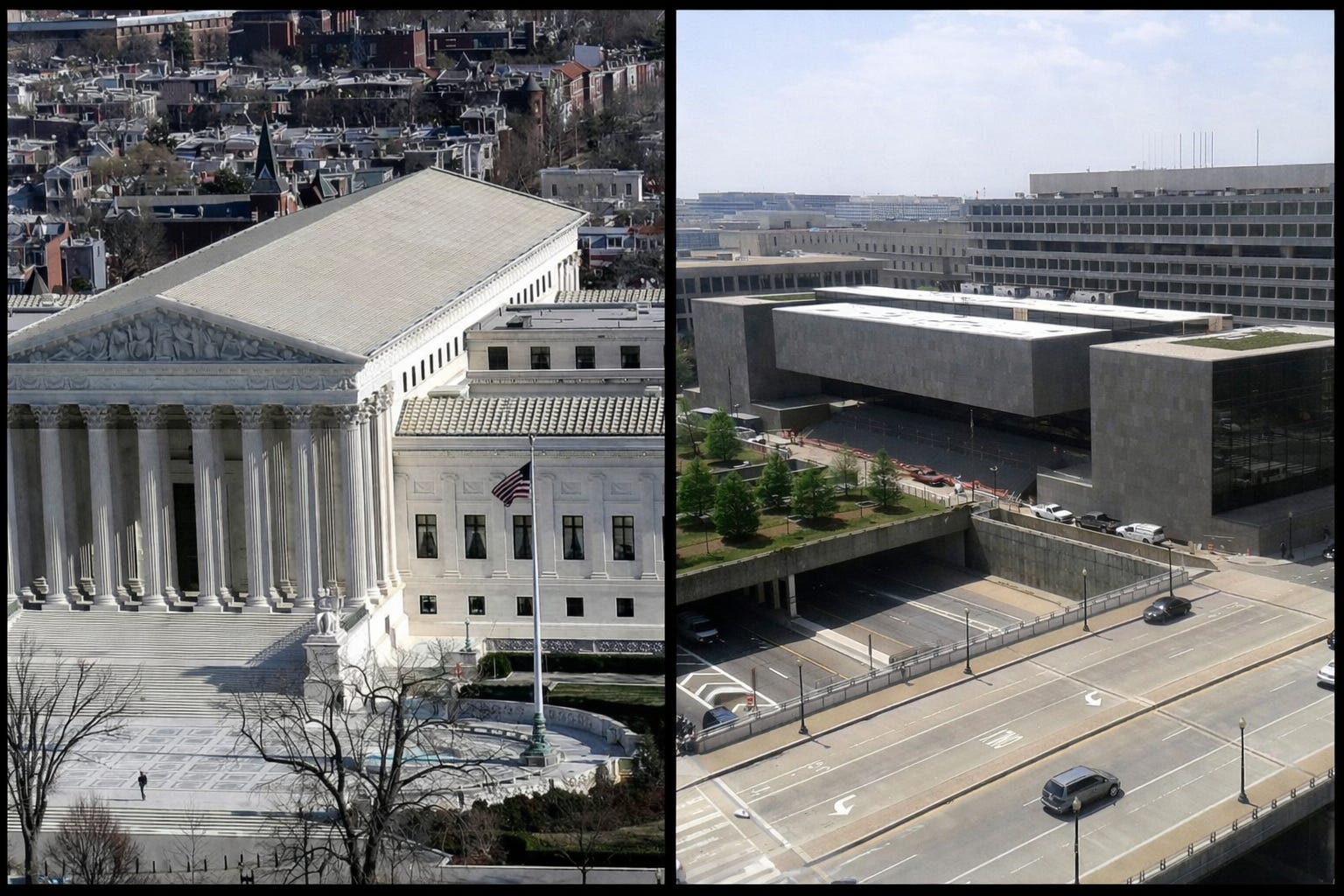
Symmetry for symmetry’s sake is impersonal and inert. It can only create venustas if joined to elements whose balanced proportions mimic nature and the human body—two forms that seem to resonate with our aesthetic sensibilities more than any other.
The Science of Humane Architecture
Individuals thrive in environments that honor human-scale proportions where form follows function. Consider the soaring nave of a Gothic cathedral: its vertical thrust mirrors our spiritual aspirations, while its intricate stonework reflects the fractal patterns we instinctively recognize from nature. Contrast this with the typical American post office: a sharp rectangle with a plain entryway and a colorless flat roof. Churches and post offices have different functions. But you get the point. The same utilitarian template used for virtually every post office in the United States has been replicated across millions of commercial and institutional buildings, sowing aesthetic monotony across the American landscape.
In addition to stimulating our natural propensity to appreciate proportion, aesthetic variety also shows fascinating medicinal properties. A landmark study by Roger Ulrich discovered that post-surgical patients assigned rooms with views of trees recovered from surgery significantly faster, required less pain medication, and experienced fewer complications than those facing plain brick walls.
We are natural creatures. Our mental and physical well-being is inextricably linked to nature and its rhythms. Yet we now spend most of our time in offices, shops, and other artificial indoor space. Built environments directly affect our health, healing, and longevity. Exposure to visually rich, ordered, “natural” environments can help our bodies heal, or avoid becoming ill in the first place.
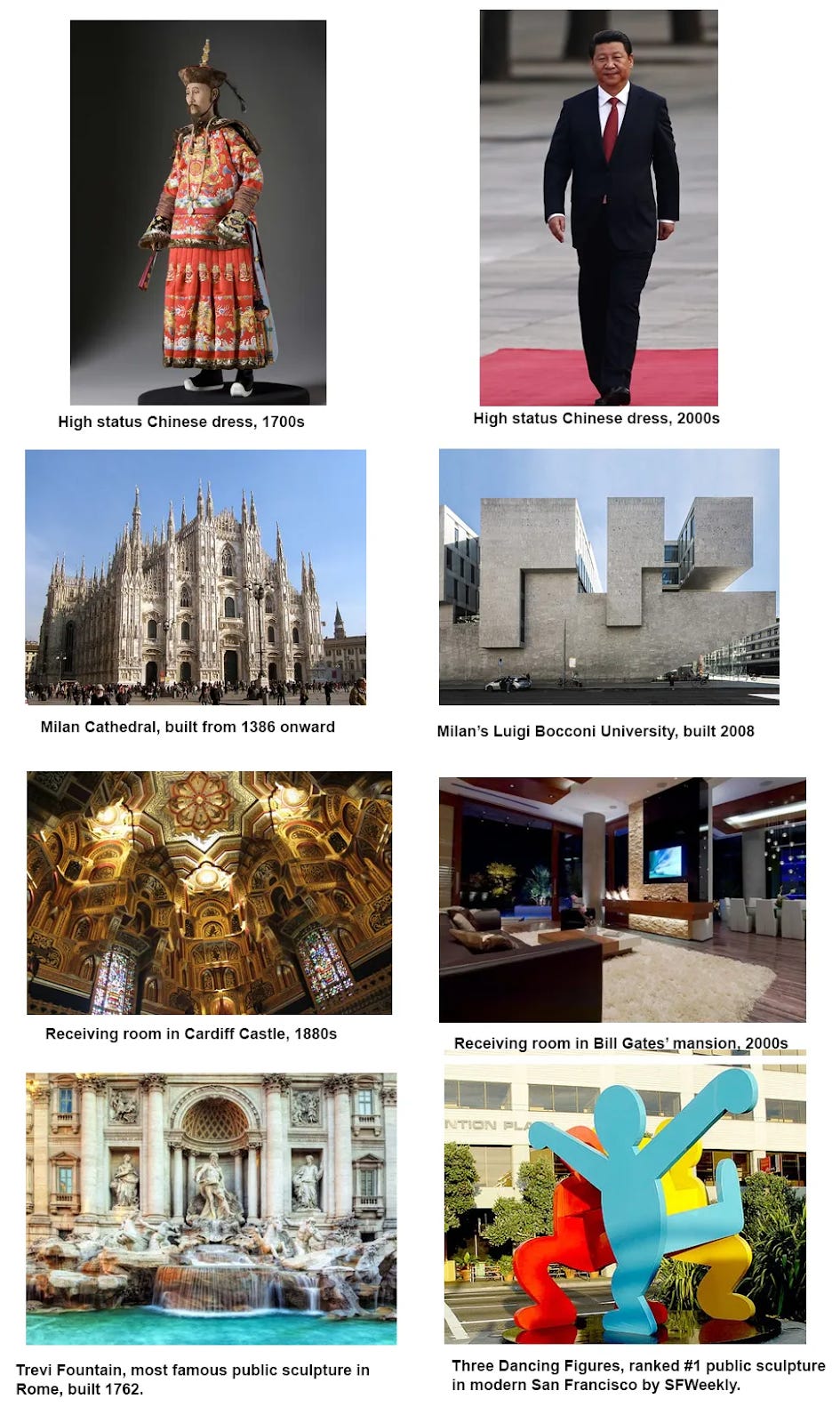
Why Did We Stop Building Like the Ancients?
Today, the global architectural scene largely neglects classical architecture. Above, we briefly discussed some compelling reasons for the durable modernist bias that still dictates most contemporary construction projects (i.e., trauma from the Great Wars, autistic architectural “geniuses” obsessed with simplicity and sharpness rather than proportion and ornamentation, etc.).
The architects of the early 20th century seemed intent on replacing the potent but ordered emotive responses a fractal building like La Sagrada Familia can elicit with shapes and colors that offer potentially infinite conceptual interpretations, with only a narrow set of reactions, usually involving confusion, disaffection, or, as we’ve seen, unfavorable aesthetic judgment. Whatever its reasons, the rejection of classicism’s unifying symmetry has radically transformed public environments from rich sources of beauty that display the depth of the human experience to bleak reminders of monotony, and little else.
The Architects of the future will have to counter this rejection. They will have to build for human beings, not for vested interests and niche preferences. They will have to renounce modernism’s attempts to suffocate beauty in the name of profit and expediency. They will have to build for the same overarching reason humans have always built: to stir the spirit and inspire the best in all of us.
When profit rules, buildings become mere artifacts. When disposability dictates, nothing is built to last. When expediency defines the aesthetic character of our public and private spaces, we in turn reflect it upon ourselves. When community becomes commodity, society disintegrates.
The Long-time Horizon of an Architectural Paradigm
In just three decades (between 1950 and 1980), the appearance of cities was utterly transformed in modernist fashion. Walking through most urban centers today means moving through an elite’s flat vision of progress, crystallized in alienating glass and concrete.
What will it take to reverse the trend? What will it take to revive venustas?
Expert, actionable answers about how to bridge past and present to engineer a better future abound. We’ll limit ourselves to articulating those general principles that underlie them:
A new golden age of Architecture is approaching. Yet, building a better future does not mean copying the past. Therefore, we will need to foster a new generation of builders eager to combine traditional and contemporary techniques. To do so, we will have to emphasize the need for and value of trade schools, abandon the erroneous belief that modern means cheaper, and advocate for educational initiatives that seek to restore holistic, classical architecture as a universal baseline.
The landscape of future discoveries is virtually infinite. In keeping with a commitment to bridging ancient principles and contemporary techniques, more money and attention should go toward developing or refining potentially scalable and cost-effective tools (e.g., 3-D printers). Research into material science will be essential to procure better materials, including but not limited to durable, weather-resistant pigments and coatings that will re-color our increasingly visually impoverished world.
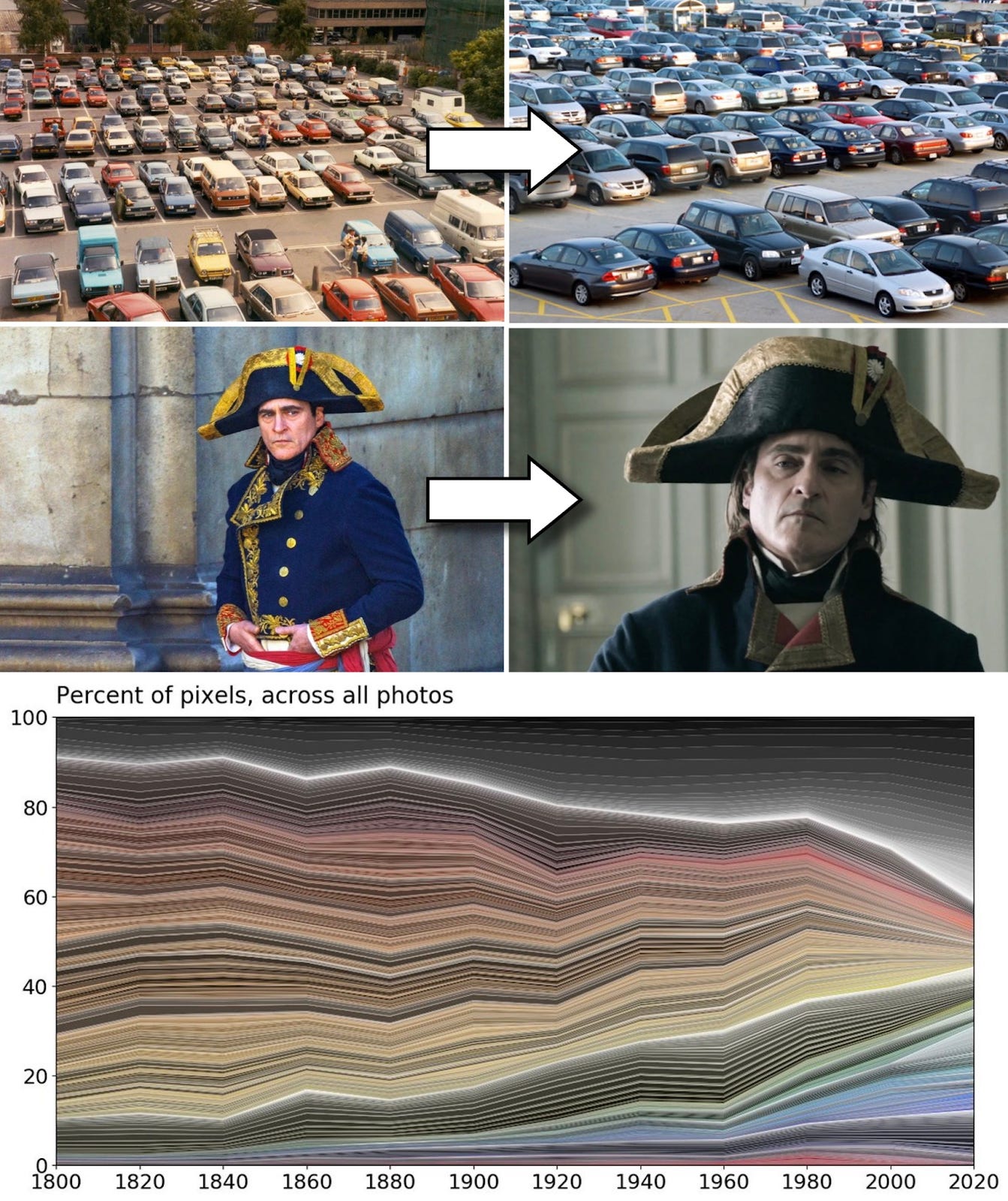
Government contracts ought to favor classical principles in infrastructure projects (i.e., bridges, transit stations, etc.), requiring city planners to integrate color and ornamentation. Building codes that inadvertently favor cheaper, simpler, modernist designs ought to be revised, if not altogether repealed. Sister cities offer productive examples to ensure that new urban spaces mimic the best and most rewarding aspects of architecture.
In the United States, federal renewable energy credits created an entirely new industry devoted to the production and installation of windmills, electric cars, solar panels, and other similar technologies. Similar monetary incentives will prompt builders and entrepreneurs to pivot towards better architectural principles.
The Human Search for Beauty
For Vitruvius, the human search for beauty was as natural as any biological function. As he noted, “the eye is always in search of beauty.” This natural tendency helps explain Americans’ overwhelming rejection of modernism, whose intimidating, impersonal appearance obfuscates purpose and stunts aesthetic potential. “If we do not gratify its desire for pleasure” with appropriate architecture, the “clumsy and awkward appearance” of poorly planned public and private spaces will leave us sorely wanting.
On December 21, 2020, the Trump Administration issued an Executive Order for “Promoting Beautiful Federal Architecture” to “ensure that all Federal building designs command respect of the general public for their beauty and visual embodiment of America’s ideals.” The Order sought to establish classicism as the default style for future federal buildings, leaving room for other styles only when judged appropriate1.
But is it enough to “mandate” classicism? Can an aesthetic revolution really be legislated? What role will “grassroots” initiatives play in refining our palate for architecture that serves the whole human being?
In his Preface, Vitruvius explained to Augustus the main reason for writing his manual: “in future also you will take care that our public and private buildings shall be worthy to go down to posterity by the side of your other splendid achievements.”
Architecture is the only artform no one can ignore. It’s one of the most evident symbols of a nation’s legacy, and of the people who have built it.
Buildings do more than store items, offer services, or display the latest fashion. Architecture is not decoration, but an outward projection of the human soul. As such, it should inspire the human spirit and ennoble its bodily existence.
As Dostoevsky said, “beauty will save the world” — only if we let it.
The Biden administration revoked the mandate, which the second Trump Administration reinstated on August 28, 2025.
Bring back brutalism! I have a soft spot for how it manifests certain political and economic ideas…. But you could say this of all architecture. Enjoyed your exploration of these two dominant approaches to the built environment.