


[Man’s Search for Meaning has inspired millions of readers from across the world to find meaning in hopeless and insufferable conditions. This essay is dedicated to Viktor Frankl, who has provided me with the tools to find meaning in any and every situation. My hope is that this short essay will have a similar effect on the reader. None of these ideas is my own, but everything I learned from Frankl.]
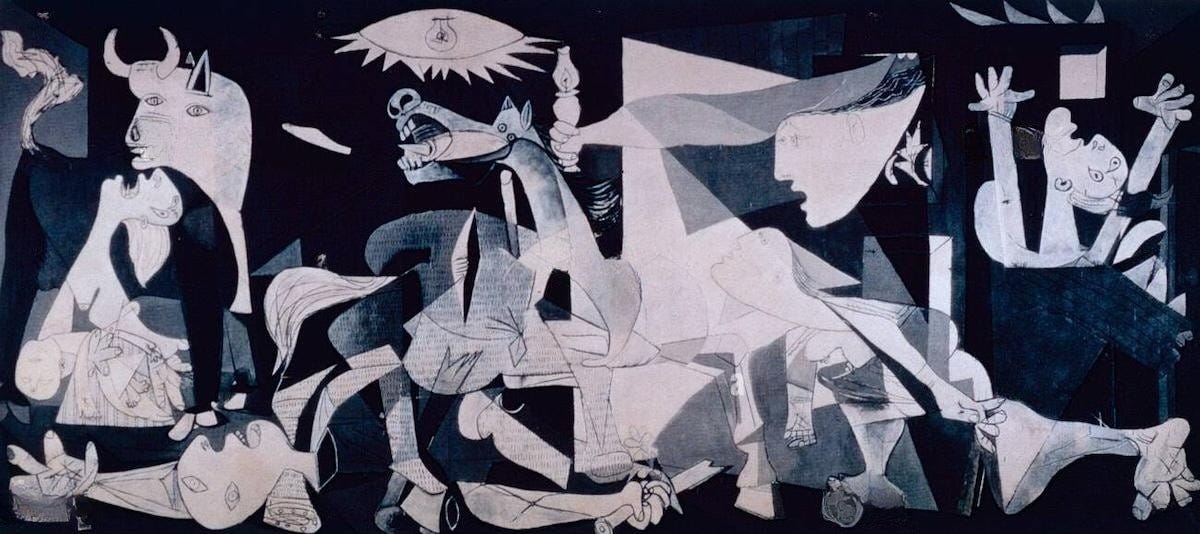
Why must we reaffirm the resilience of the human spirit? Because when God was declared dead, the great structures of meaning that once sustained humanity collapsed. What followed was a void, and into that void rushed a pervasive experience of existential dread.
Now and then, we will find ourselves in a hopeless abyss, where the light is quenched by darkness, and life’s meaning hides beneath the shadows. When Viktor Frankl found himself surviving the monstrosities of Auschwitz1, he asked himself an unanswerable question, a question unfathomable for a person in his situation: Is there meaning in my life as a prisoner in Auschwitz? To understand Frankl’s point, we must first answer the question: Where does man’s resiliency come from?
Nietzsche stated that “he who has a why to live can bear almost any how.” Frankl alluded to this maxim in a passing comment on the fate that struck prisoners who forwent their ‘why’, “woe to him who saw no more sense in his life, no aim, no purpose, and therefore no point in carrying on. He was soon lost.” The man who loses sense of his future will lose his taste for life. What is then needed when we are lost is to change our attitude towards life by confronting each moment with full attention and acceptance. It does not matter what we expect from life; all that matters is what life expects from us. Life confronts us at every moment, calling upon us to answer it, calling upon us to create meaning.
The Will to Meaning
Man is able to live, and even to die for the sake of his ideals and values. - Viktor Frankl
When man’s willpower is thwarted by pleasure-seeking, his likelihood of standing up for his ideals diminishes dramatically. Consider how easily a person abandons their principles when immediate gratification beckons: the activist who stays silent to avoid social discomfort, the professional who compromises their ethics for a promotion, the citizen who ignores injustice because confronting it would disrupt their comfort. The person oriented toward meaning can endure hardship because they see it as instrumental to something beyond themselves; the pleasure-seeker cannot, for pain serves no purpose in their calculus. It goes to zero when purpose becomes synonymous with pleasure, and his time-preference shrinks to ‘now’.
The search for meaning is always top of mind, especially for the young and old. For the young, life has not yet formed; every decision feels weighty with possibility, every path a potential identity to inhabit. For the old, life is falling apart, the structures that once provided certainty crumble, and the years demand some accounting, some coherent story that justifies what has been. The individual in search of meaning, though genuine he is, will become distracted or misaligned, taking on identities and pursuits that serve his animalistic side or conforming to what is ‘expected’ of him. He becomes the corporate climber chasing status, the student pursuing prestige over passion. The meaning that the individual creates is not his own, resulting in a longing for an ultimate meaning. A gnawing sense that something essential is missing, that the life he’s constructed, however successful by external measures, rings hollow. The individual will not be content until that ultimate meaning is realized (Super-Meaning).
It is a noble pursuit to search for the most meaningful life possible; it is a natural response to life that will set one off on the journey of a lifetime. When meaning is pursued, the guardrails surrounding a normal life are removed: the highs are higher, and the lows lower. Adventure awaits the soul that wills meaning into existence.
A common condition resulting from the search for meaning is existential frustration2. The psyche becomes frustrated when meaning does not emerge. The result is noogenic neurosis3, resulting from existential problems, rather than a conflict between drive and instinct. Among such problems, the frustration of the will to meaning plays a large role. Frankl explains that existential frustration is not a pathology, but an all too human trait. Those who see the frustration as a disease will inevitably treat the disease with tranquilizing drugs and distractions. The individual will do anything to cope, rather than deal with his existential frustration.
Logotherapy, developed by Frankl as a therapy for existential frustration, “considers man a being whose main concern consists in fulfilling a meaning, rather than in the mere gratification or satisfaction of drives and instincts, or in merely reconciling the conflicting claims of ID, ego and superego, or the mere adaptation and adjustment to society and environment.”
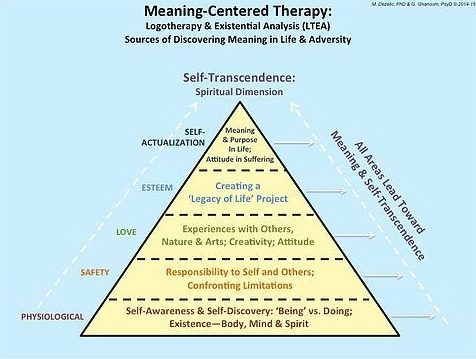
The human spirit is resilient and will overcome any obstacle when it has a task to complete. Those who are most apt to survive a concentration camp have something to look forward to; the opportunity of the future lightens the misery of the day. The prisoner clings to the unfinished work waiting at home, the responsibility to bear witness, the loved one who needs him to return. Even the simple determination to prove that one’s captors could not break one’s spirit becomes a sufficient purpose to endure the unendurable. The tension between what one is and what one could become creates the condition not only for survival, but to grow from the confronting challenge.
What man actually needs is not a tensionless state but rather the striving and struggling for a worthwhile goal, a freely chosen task.” - Frankl
The Aimless Spirit
No instinct tells him what to do, and no tradition tells him what he ought to do; sometimes he does not even know what he wishes to do. Instead, he either wishes to do what other people do (conformism) or he does what other people wish him to do (totalitarianism). - Frankl
With frustration and aimlessness, the human’s will to meaning is compensated with the will to power or the will to pleasure; often, we will oscillate between both. Our day is filled with repeating moments of anxiety and boredom. There is no guiding force, and so we find ourselves in a world totally alien to us. With aimlessness comes disorientation and meaninglessness. Young people want to know what the meaning of their life is, but with no tradition to guide them, they find themselves stumbling towards nihilism.
A 2023 study by Harvard4 indicated that three in five young adults between the ages of 18 and 25 reported they lacked “meaning or purpose” in their lives. Not surprisingly, the percentage of people with meaningful lives increases when asking individuals above the age of 25. The improvements show a development of character as well as social responsibilities, which Frankl argues are both prerequisites for a meaningful life.
A majority of the existential dread people feel stems from a disconnect between their lives and the world. We spend our days engaging with mediated experiences: staring at screens, curating unrealistic digital identities, interacting with life through layers of technological filtering. This constant mediation dampens the real-world feedback our psyches evolved to rely upon. Life confronts us with real challenges and demands real responses. Thus, it is our duty to be responsible for cultivating our own meaning. Meaning is discovered through direct engagement with the world as it presents itself, making it unique to each individual. Religion unifies a people through shared purpose, while life creates freedom by requiring each person to discover their own.
In a word, each man is questioned by life; and he can only answer to life by answering for his own life, to life he can only respond by being responsible. - Frankl
Aiming at a Target
The more one forgets himself by channeling his energy toward a cause to serve or loving another person, the more he will actualize himself. “In other words, self-actualization is possible only as a side-effect of self-transcendence.” Following this logic, logotherapy offers three different ways for discovering meaning: 1) by creating a work or doing a deed, 2) by experiencing something or encountering someone, and 3) by the attitude we take toward unavoidable suffering. The first is obvious; the second I will touch on briefly, and then I will elaborate on the third, thereby affirming the resiliency of the human spirit.
The human spirit is satisfied through the meaning it finds by experiencing something — “such as goodness, truth, and beauty.” Nature pulls us out of ourselves and into the meaning of life. When you love her, you find meaning in the relationship. When we confront beauty or experience truth, we see that very potential in ourselves, something that should be actualized, but has been kept dormant until the experience pulls it out of us. The exterior world illuminates essential aspects of ourselves, traits and virtues that we then embody.
Finally, we find meaning in suffering, or put more poetically, we find meaning in the resiliency of the human spirit to overcome suffering and tragedy. This ability of the human spirit to be resilient in the face of suffering can be expressed in no better words than those of Frankl: “Human potential at its best is to transform a personal tragedy into a triumph, to turn one’s predicament into a human achievement.” This human potential creates the reality that “man is ready to suffer, on the condition that his suffering has meaning.”
Logotherapy’s triad of meaning means that life’s meaning is unconditional, “for it even includes the potential for meaning in unavoidable suffering”. The human spirit is anti-fragile, for even at its lowest, it is able to be ennobled.
Ultimately, we all surrender to life; death is the promise to all who walk this Earth. If meaning were only to be found in life, then it would be pointless, for anything so fragile and finite cannot sustain the infinite cycle of life and death. Meaning is not conditional, but an unceasing instrument, playable in each and every situation, even that of unavoidable suffering.
The Human Spirit is Self-Determining
The human spirit is not free from its conditions, but it is free to take a stand toward the conditions” - adapted Frankl
Pan-determinism is the belief that everything in human life is fully determined by external forces, biological factors, or prior causes, leaving no genuine room for freedom, choice, or inner agency. Frankl offers a rebuttal to pan-determinism by explaining that “man is not fully conditioned and determined but rather determines himself whether he gives in to conditions or stands up to them… man does not simply exist but always decides what his existence will be, what he will become in the next moment.”
Frankl tells the story of a Nazi named Dr. J., who was in charge of the Nazis’ euthanasia program. He had believed Dr. J. to be the only truly evil man he had ever met, yet when Frankl later encountered a man who knew Dr. J. from his time in a Lubianka prison in Moscow, the man stated about Dr. J., “Before he died… he showed himself to be the best comrade you can imagine! He gave consolation to everybody. He lived up to the highest conceivable moral standard. He was the best friend I ever met during my long years in prison.”
Predicting man’s behavior is impossible. There are those who can “predict the movements of a machine or even predict the dynamics of the human psyche, but man is more than psyche”. Man is spirit, and his spirit is self-determining. “If humans were not more than a determined brain machine, then euthanasia would be justified.” After all, we don’t hesitate to discard a malfunctioning machine or put down a computer whose circuits have failed beyond repair. If consciousness is merely the output of neural processes, and those processes become irreparably damaged, what argument exists against ending that process? The machine perspective reduces human life to functional capacity: when the function ceases, so does the value. No matter how broken a human is, no matter how psychotic, he retains the dignity of a human being.
A human being is not one thing among others. It is things that determine each other, but man is ultimately self-determining. What he becomes — within the limits of endowment and environment — he has made out of himself. - Frankl
Conclusion
Men have lived through terrible existences. They have suffered in concentration camps and experienced unimaginable tortures. While some acted as swines, others became saints. Frankl concludes that “Man has both potentialities within himself; which one is actualized depends on decisions but not on conditions.” There is no force in the world that can take away man’s freedom to confront all conditions of life with his head held high, and his dignity preserved beyond the reach of circumstance.
I cannot help but complete this essay with the very ending that Frankl chose to complete his own:
So let us be alert — alert in a two-fold sense:
Since Auschwitz we know what man is capable of.
And since Hiroshima we know what is at stake.
Frankl, Viktor E. Man’s Search for Meaning. Beacon Press, 1959.

Existential frustration is the sense of inner distress or tension that arises when a person’s deep drive for meaning, purpose, or direction is blocked or left unfulfilled. It occurs when the will to meaning collides with circumstances, uncertainty, or a lack of clarity about one’s path, creating a feeling of emptiness or disorientation.
Noogenic neurosis, a term from Viktor Frankl’s logotherapy, refers to psychological distress that arises specifically from a crisis of meaning rather than from emotional conflicts or mental disorders. It appears when a person feels their life lacks significance, values, or purpose, leading to emptiness, apathy, or existential despair.
Weissbourd, Richard, et al. “On Edge: Understanding and Preventing Young Adults’ Mental Health Challenges.” Making Caring Common, Harvard Graduate School of Education, Oct. 2023, https://mcc.gse.harvard.edu/reports/on-edge.
Top drivers of young adults’ mental health challenges
A lack of meaning, purpose, and direction: Nearly 3 in 5 young adults (58%) reported that they lacked “meaning or purpose” in their lives in the previous month. Half of young adults reported that their mental health was negatively influenced by “not knowing what to do with my life.
Financial worries and achievement pressure: More than half of young adults reported that financial worries (56%) and achievement pressure (51%) were negatively impacting their mental health.
A perception that the world is unraveling: Forty-five percent (45%) of young adults reported that a general “sense that things are falling apart” was impairing their mental health.
Relationship deficits: Forty-four percent (44%) of young adults reported a sense of not mattering to others and 34% reported loneliness.
Social and political issues: Forty-two percent (42%) reported the negative influence on their mental health of gun violence in schools, 34% cited climate change, and 30% cited worries that our political leaders are incompetent or corrupt.